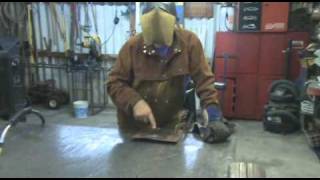
 (Text on screen): MIG Welding: Setting Voltage and Wire Feed, Kevin Caron, www.Kevincaron.Com Kevin Caron: So, a question I get asked a lot is, "How do you set the dials on the MIG welder? Where do you start?" "How to you know where to set it at for, like, a piece of 16-gauge, versus, like, a piece of, like, quarter-inch?" Come here. I'll show you. So, on the 251 Miller, Miller was nice enough to give a chart with rough settings so we can kind of know where to start from. So, come here.
Take a look. Come here, come here, come here. And you can probably find this on the Miller site if you look around for it. You've got a chart that shows you, you know, asks you, "What are you welding?" Steel; you know, steel for outdoor, windy applications, stainless, aluminum.
It suggests wire type: solid core or flux core, stainless wire, aluminum wire. Shielding gasses: that's the stuff in the bottle. Hundred percent. I mean, it's all right here.
It spells it all out for you. Different wire sizes. I'm running 035 wire in this machine right now, so we'll set the machine up for that. And then it shows you the different sizes of metal: half-inch, all the way down to 22-gauge.
So, I've got a piece of 16-gauge sitting on the bench. And we're running 035, with a mixed gas, so it's 75 percent argon, 25 percent CO2. So we know we want to start with about 16 amps and about 165 on the wire. So, come around the other side of the machine; come around on the front over here and we'll set it up there and just see how that works.
So, we want 16 on the volts (come on, fingers). And we want 165 on the wire. It's always gotta be difficult. Close enough.
OK, so let's put our helmet on and we'll come over to the table and we'll give that a try. And we'll look at what it does and figure out if we want to raise it up or lower it down. OK, so let's just run a little bead and we'll see how the settings work. Watch your eyes! (Welding) Pick up your helmet.
Here, come here. Zoom in right here. Can you see this? The Voice: Ah. Yeah.
Kevin Caron: See, this is the first little part that I did where; a quirk with big welders, especially one with an extra-long cable, is you have to purge the cable first thing in the morning to get your shielding gas back up to your tip again. So, that first little bit I did right there, I didn't have any shielding gas. That's why it sounded different. That's why it made a little bit of a mess right there.
And then I started over and I put a bead down, and it worked just fine, because I had gas. OK, so looking at the weld, you can see the weld turned out really nice. It's nice and flat, it's smooth, there's no big gaps or anything in it. But you can see it's a little lumped up; see, kind of tall in here where it didn't get a lot of penetration.
And that's either the wire feed was a little too fast or the amperage was a little too low, or maybe I just moved a little too quick. Let me just mess with the controls Let me turn the amperage down a little and I'll turn the wire feed up a little, way out of proportion, just so you can see the difference. Hang on. The Voice: How much of the time do you have to, sort of, interpret what you're doing and just kind of get the feel of it and know what you're doing? Kevin Caron: All the time.
All the time. Those gross settings over there are just kind of a starting point, but you really have to take into account the metal that you're working on, how thick it is, it is clean, is it dirty, are you inside, are you outside? I mean, these are all different things that you have to keep in mind as you're working. And you have to change as the situation changes, as you're working. So, the setting that will work right now, five minutes from now may be wrong.
You may have to go over and give it a little more amps, a little more wire or a little less, and you've really just got to kind of play with it. And it's really something you learn over years of experience. The Voice: Are there any sounds that you can listen for? Kevin Caron: Oh, yeah. We'll talk about that in a minute.
Hang on. OK, so I've turned the amperage down. The Voice: To what? Kevin Caron: To 14.7; Just gave it a twist. And I turned the wire feed up to 200.
Now. Go ahead; put your helmet back on. Let's see what happens now. (Welding) Boy, does that a mess.
Pick your helmet up. There, come on over here. See this. The Voice: Oh my gosh.
Kevin Caron: Big difference, huh? The Voice: What a mess! Kevin Caron: Yeah. Now, see, that's too cold and the wire's too fast. Didn't you hear it hop and skip and pop and carry on and, you know, it skips in the middle of the weld right there because the wire's coming out so fast you can't get a steady bead going. So, let me turn the controls the other way now and we'll see the difference over there.
So now we're up to 18 volts and only 135 on the wire feed. So, now, lots of amperage and very little wire. Put your helmet on. Ready? The Voice: Go.
(Welding) Kevin Caron: Pick your helmet up. Now, that sounded a lot better. Here. Come here and take a look.
See the difference? The Voice: That's purty. Kevin Caron: Yeah. This is pretty good. See, this is a little high right in here where I may have been moving a little too fast, but this was starting to sink down in where I slowed down a little bit, and that's where the extra amperage was coming in; the extra voltage, where it's starting to penetrate into the metal.
Which, you can hear the difference in the sound. More like bacon sizzling rather than firecrackers going off, you know what I'm saying? So, that's kind of how it works. You've got to play with it. You've got to practice with it.
But keep trying. You'll get there. The Voice: Did you learn this in school, Kevin? Kevin Caron: No, I did not learn this in school. Thank you for bringing that up.
I am self-taught. I have learned all this on my own, so I am not a professional in any shape or form. Take everything that I say right here on this video with a grain of salt. This is just stuff I have learned; I have taught myself how to do.
So, if it's wrong, I apologize. But it works for me. So, until next time. Subscribe to See More Videos, See and Hear More at KevinCaron.Com..

No comments:
Post a Comment