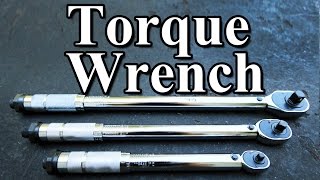
 Hey guys, ChrisFix here and today I'm gonna show you how to properly use a torque wrench. A torque wrench is used to tighten down nuts and bolts to a specific torque. You should use a torque wrench because you can easily over-tighten nuts and bolts and damage the threads. Or, you could even snap the bolt head right off.
Also, if you don't tighten nuts and bolts enough, they could come loose, which would be very bad. All torque is is a rotational force, or a twisting force and while working on cars, you'll be rotating a nut or a bolt. And that can be while working on different parts of the car, such as the suspension, the wheels, the brakes, and even while working on the engine. So let me show you how to use a torque wrench All these right here are torque wrenches.
We have a 1/2" drive, we have a 3/8" drive, and we have a 1/4" drive. And then here's the one I use all the time, which is a 1/2" drive. Now let's say we want to torque down the lug nuts on a wheel. Most wheels, the lug nuts are tightened to 100 lb-ft of torque.
And yes, the right way to say it is "pound-feet" of torque not "foot-pounds" of torque. But, everyone says "foot-pounds" of torque I even say "foot-pounds" of torque and it's really not that important how you say it. But anyway, get your click-adjustable torque wrench which is the most common type of torque wrench and what we're talking about in this video. So, to adjust the torque wrench, the first thing you do is you go down to the end here and you loosen this little knob down here and that allows the handle to freely move back and forth You want to make sure you're using the correct units in this case we're using foot-pounds but if we go to the other side of this wrench you can see here there [are] different units because not everybody uses foot-pounds and then what we're going to do is we're going to look for 100.
So our torque is 100 foot-pounds, you can see right there we have 100 foot-pounds so what we're going to do is we're going to rotate this until our 0 right here meets that 100 foot-pound line right there so now we're going to just turn this handle until that 0 mark lines up with the 100 mark. So right now our 0 is lined up to that one which is 90 foot-pounds We want to get to 100 So that would be 91, 92, 93 96, 97, 98 99, 100 The zero lines up with 100 And we are set to 100 foot-pounds If you wanted to do 99 you just move it one click down and that's 99, 98 right there. If we want 101 We go 100 and 1 102 102. Once we have it all lined up you're going to take your locknut back here and then turn it clockwise until it locks this in place, so your torque spec doesn't change when you're trying to tighten it down.
Then all you do is you get your torque wrench, put your socket on your torque wrench put it on the lug nut you put your hand on the handle part that you were adjusting before and you tighten. And the click means that you've reached your desired torque. So you're done. Move on to the next lug nut that you want to torque down.
It's as simple as it looks, just tighten it until it clicks, and then you're good to go. Now I know the lug nuts are the correct tightness so I don't have to worry about damaging the studs or having the wheel fall off. And that's really all there is to it it's very simple to do nothing complex at all. As easy as these things are to use, there are a lot of top tips that I can give you.
Such as, where do I get my torque specs? How do you take care of these? Where do you store them? What about the calibration? Can I use extensions? And another big question is: where do I get a good torque wrench? So the first top tip I want to cover is, where do I get my torque specs? This is where I get my torque specs from. I buy the service manuals for the cars I own because I know I'm going to work on them. And the service manual tells you the basic steps to repair the part and it gives you the torque specs for the nuts and bolts that you're going to tighten down. The other method to get a torque spec is to just do a search online.
For example, if I'm working on a Trailblazer, and I want to get the axle nut torque spec, I'll search "2004 trailblazer axle nut torque." And you can see there are a bunch of relevant results and this guy says 103 lb-ft and he says he's quoting the service manual. So those are the two methods I use. The next top tip is taking care of your torque wrench so it lasts a long time. Make sure you don't drop this or impact it hard when you're turning this, because that could throw off the calibration.
Sure, if you drop it once, you know, it's not gonna mess it up. But if you're constantly dropping it, or you drop it from really high up, you know, this is probably gonna knock out of calibration. The other thing is, you want to keep this dry and out of places it could get rusty. Most torque wrenches come in a case, so use it.
This case protects it from moisture and shock. But before you put it in a case, you want to remember something: inside this torque wrench is a spring, which is under pressure. The more you tighten the torque wrench handle, the more pressure there is on the spring. When you store the torque wrench, you want to store it [at] the lowest setting.
So loosen it up all the way, and once you get it all the way loose, tighten it, a little bit past the lowest setting. That'll keep slight tension on the spring so it's not completely loose but the spring will be unloaded and it'll make your wrench stay in calibration a lot longer. Remember, torque wrenches are precision pieces of equipment so treat them that way. The other thing is, you don't want to use your torque wrench as a breaker bar or as a normal ratchet.
Use a breaker bar that's why you have breaker bars. These are made to take the strain. You're going to wear the components in this out if you use it that much. The other thing is don't be using this as your ratchet to tighten this up all the way tighten it up most of the way with a ratchet first and then once it gets snug then you can use your torque wrench.
And then that will just keep your calibration longer and you won't have to send it in for service. Now, speaking about calibration, when should these torque wrenches be calibrated? On average, torque wrenches should be calibrated at least once a year or every 5,000 clicks. So for most DIYers, once a year is going to work. And now getting your torque wrench calibrated could be kind of expensive It ranges from $25 to $75 depending on who does it plus shipping if you have to ship it out So what I'll do is I'll test my torque wrench to see if it's in spec and I'll show you that in a different video but you can actually do that yourself so you're not shipping this out and spending a lot of money especially if you don't use it that often.
Now another top tip I have is using extensions. A lot of people are like, "Oh, you can't use extensions with torque wrenches because then the torque won't be exact." And, well, that's not completely true. You want to try to use thicker extensions. You can see these are 3/8" extensions so they're more likely to have a little bit of twist to them.
But these 1/2" extensions take a lot of force to twist. You have to realize, when you're working on cars, sometimes you have to use extensions just to get to the nut or bolt. Now, the extensions that you shouldn't be using when you're torquing stuff are universal joint extensions that have a lot of play in them and also wobble adapters, or wobble sockets which have a lot of play in them. Because this will mess up your torque reading and torque spec.
The final thing I want to cover is what torque wrench should you get? Well, there's two different things you have to look at the first thing, you need to figure out what drive torque wrench you want. And the drive is what size the stud is. So here we have 1/4" drive, here we have 3/8" drive, and here we have 1/2" drive. So if your socket says 3/8, you might consider getting a 3/8.
But that's not the only thing to think about. The other thing you have to think about is what torque spec you're going to typically torque down your nuts and bolts to. So the 1/4" drive uses inch-pounds which is for tightening smaller nuts and bolts I typically don't use this. And then we have the 3/8" drive and the 1/2" drive The 1/2" drive goes from 20 to 150 ft-lb which is the range that I like, this is what I use most of the time.
And the 3/8" drive goes from 10 to 80 ft-lb, which is a decent range but a lot of times, especially [like when] we just did the lug nuts we won't be able to use this. So once you figure out what size drive you want, and what torque range you're going to be using the most, you want to figure out what price range you're in. The more expensive wrenches like SnapOn are definitely better but you can get a decent, inexpensive wrench. This is inexpensive, and I've had it for a few years now, it's what I use in all my videos No need to break the bank 1/2" drive 20 to 150 ft-lb and it's what I recommend to everybody.
I'll leave a link in the description to a torque wrench that is a good price and is really good quality for the price. It's not gonna break the bank, you'll be able to buy it yourself, and use it at home, it's good for all the DIYers, home mechanics, but those are things that you have to think about. So now you should know everything you need to know about torque wrenches! Hopefully the video was helpful! If it was, remember to give a thumbs-up. If you're not subscribed, consider subscribing!.

No comments:
Post a Comment